
California Auto Insurance Laws After Accident

California law requires drivers to carry minimum liability insurance to cover damages in the event of an accident. Following a collision, drivers must promptly report the incident to their insurance provider and exchange information with other involved parties. Failure to maintain valid auto insurance can result in fines, license suspension, or vehicle impoundment.
California is a fault-based insurance system, meaning the driver found at fault is typically responsible for covering damages and injuries. Understanding these legal obligations helps ensure compliance and protects drivers during the claims process after an accident.
Understanding California Auto Insurance Laws After an Accident
After a car accident in California, drivers must navigate a set of specific insurance regulations designed to ensure responsibility, timely reporting, and proper compensation. California operates under a fault-based insurance system, meaning the driver found at fault for the accident is financially responsible for damages and injuries.
 Common issues with home insurance claims
All drivers are required by law to carry minimum liability insurance coverage, which includes $15,000 for injury or death to one person, $30,000 for injury or death to more than one person, and $5,000 for property damage (often referred to as 15/30/5). Failing to maintain this coverage can result in fines, license suspension, and even vehicle impoundment.
It is also mandatory to report accidents to the DMV within 10 days if there is property damage exceeding $1,000 or any injuries, regardless of fault. Understanding how these laws apply after a crash is essential for protecting your rights and avoiding legal consequences.
Reporting Requirements After a Car Accident in California
In California, drivers involved in a car accident must report the incident to the Department of Motor Vehicles (DMV) within 10 days if there is injury, death, or property damage exceeding $1,000. This requirement applies even if the accident was minor or the driver’s insurance company has already filed a claim.
Failure to file a SR-1 form with the DMV can lead to license suspension. Additionally, if law enforcement responds to the scene, a police report is typically generated, which can support insurance claims and legal proceedings. Accurate and timely reporting ensures compliance with state law and helps establish a clear record of the incident, which may be critical for insurance settlements.
 Compare san antonio home insurance
California's Minimum Insurance Coverage Requirements
California law mandates that all drivers maintain a minimum level of auto liability insurance coverage, specifically $15,000 for injury or death per person, $30,000 for injury or death per accident involving more than one person, and $5,000 for property damage. This 15/30/5 coverage is the legal minimum, but drivers may choose higher limits to better protect against significant liability.
Uninsured motorist coverage is optional but highly recommended, especially in areas with high rates of uninsured drivers. Driving without the required insurance can result in fines ranging from $100 to $200 for a first offense, license suspension, and even impoundment of the vehicle. Proof of insurance must be carried at all times and presented upon request by law enforcement.
How Fault Affects Insurance Claims in California
California uses a comparative negligence system, which allows multiple parties to share fault in an accident. Under this rule, each driver’s compensation for damages is reduced by their percentage of fault. For example, if a driver is found to be 30% at fault, their total compensation will be reduced by 30%.
Insurance companies and courts assess evidence such as police reports, witness statements, and traffic camera footage to determine fault. Being partly at fault does not bar a driver from recovering damages, but it does affect the claim amount. Understanding how fault impacts settlements is crucial, especially since negotiations with insurers often hinge on these determinations.
 Home insurance claim requirements
| Requirement | California Law | Potential Penalty for Noncompliance |
|---|---|---|
| Minimum Liability Coverage | $15,000/$30,000/$5,000 (bodily injury and property damage) | Fines of $100–$200, license suspension, vehicle impound |
| Accident Reporting (to DMV) | Within 10 days if injury or $1,000+ property damage | License suspension until SR-1 form is filed |
| Proof of Insurance | Must be carried at all times in vehicle | On-the-spot fine if not presented to officer |
| Uninsured Motorist Coverage | Optional but recommended | No penalty for lacking, but increased financial risk |
| Comparative Fault Rule | Can recover damages even if partly at fault | Compensation reduced by percentage of fault |
California Auto Insurance Laws After an Accident: A Comprehensive Guide
How long does an accident affect insurance rates under California auto insurance laws?
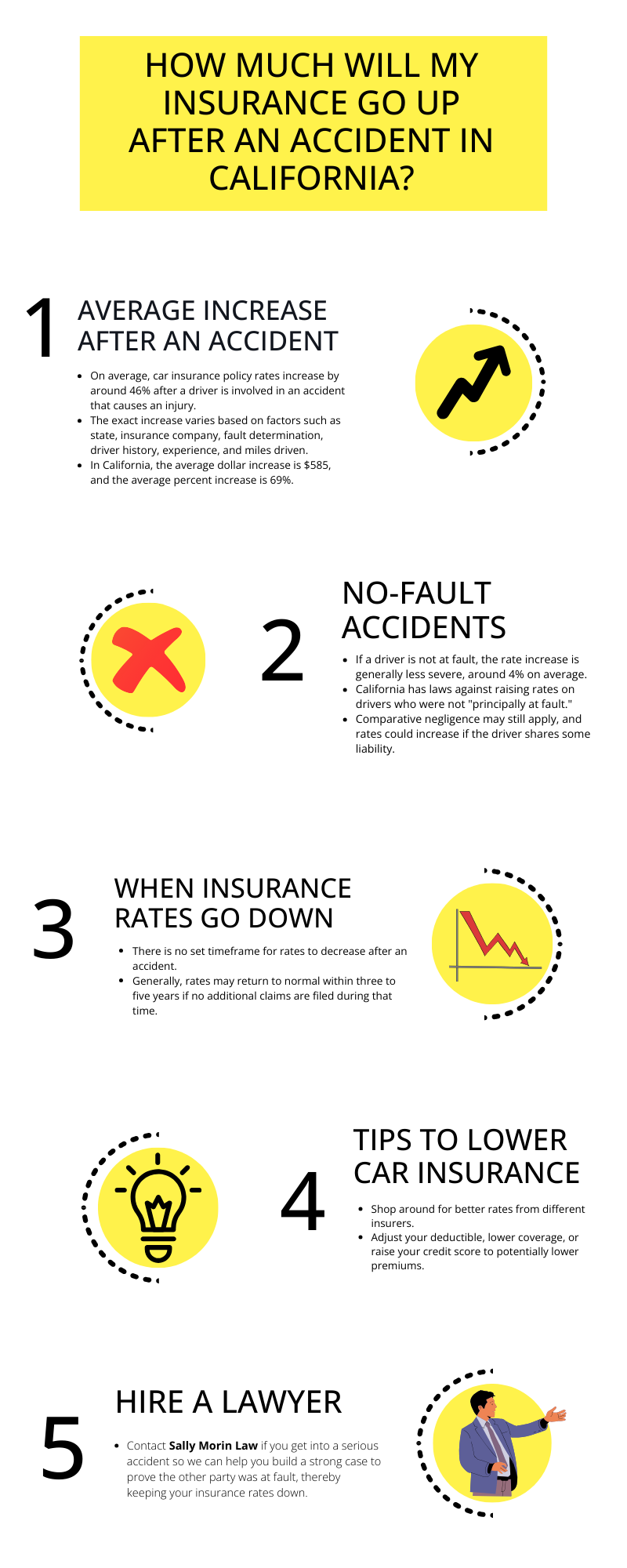
Duration of Accident Impact on Insurance Rates in California
- In California, a car accident typically affects insurance rates for three years from the date of the incident. This duration is standard across most major insurance providers in the state.
- The impact starts immediately after the accident is reported and is considered during the policy renewal process. Even if you switch insurers, the at-fault accident will likely still influence your premium with a new company.
- While three years is the general rule, some insurers may still review accidents beyond this timeframe if they are part of a broader pattern of risky driving behavior, such as multiple citations or previous claims.
Factors That Influence How an Accident Affects Your Premium
- The severity of the accident plays a major role. Minor fender benders may result in smaller rate increases compared to major at-fault collisions involving injuries or significant property damage.
- Whether you were found at fault is crucial. California follows a fault-based insurance system, so being deemed responsible for the accident usually leads to a premium increase, while being not at fault may have little to no impact if properly documented.
- Your driving history prior to the accident also matters. Drivers with a clean record may receive more leniency, while those with previous incidents may face steeper rate hikes due to perceived higher risk.
Steps to Minimize Rate Increases After an Accident
- Enroll in a state-approved defensive driving course. California law allows insurers to offer discounts for completing such programs, which may help offset or reduce the rate increase following an accident.
- Shop around and compare quotes from other insurers when your policy is up for renewal. Some companies may weigh recent accidents less heavily depending on their underwriting guidelines.
- Maintain continuous coverage and payment history. Demonstrating financial responsibility can help mitigate the increase over time, especially as the accident ages and eventually falls off your record after three years.
What are the latest changes to California auto insurance laws after an accident?
New Requirements for Post-Accident Claims Reporting
Starting in 2023, California introduced updated timelines and documentation standards for reporting auto accidents to insurance providers. Drivers involved in a collision are now expected to notify their insurer within 24 hours if the accident results in injury, death, or property damage exceeding $1,000.
This tightened reporting window aims to reduce fraud and ensure timely claims processing. Additionally, insurers may request electronic submissions of evidence, including photos of damage, GPS data, and dashcam footage, to expedite evaluation.
- The Department of Insurance now mandates that all carriers acknowledge receipt of a claim within one business day of submission.
- Drivers must retain all accident-related records for at least four years, including communication logs and repair invoices.
- Insurance companies are required to provide claim status updates at minimum every 30 days during open investigations.
Expansion of Protections Under Proposition 213 Modifications
While Proposition 213 has historically limited injury compensation for uninsured drivers, recent legislative amendments now allow limited medical cost recovery in hit-and-run scenarios—even for drivers not carrying valid insurance at the time of the crash.
 How to choose home insurance with best claims process
This change, effective January 2024, is intended to support victims caught in circumstances beyond their control. Courts are now required to evaluate fault and extenuating circumstances rather than automatically dismissing claims based solely on insurance status.
- Uninsured drivers can now file for medical expense reimbursement if the other party is identified and convicted of fleeing the scene.
- Judges must consider proof of financial responsibility attempts, such as pending insurance applications, when assessing eligibility.
- Recovery limits for these special cases are capped at $50,000 per person for medical costs, set to adjust annually for inflation.
Enhanced Use of Telematics and AI in Claim Assessments
California’s Insurance Commissioner has approved the expanded use of artificial intelligence and telematics data in determining fault and coverage after an accident, provided consumer consent is documented.
As of 2024, insurers may use driving behavior data collected from apps or built-in vehicle systems to support claim decisions, but only if the policyholder has opted into such monitoring. This development supports more personalized risk assessment but includes new privacy safeguards.
- Insurers must disclose in writing how driving data will be used and with whom it may be shared during claims processing.
- Policyholders can request deletion of telematics data 60 days after a claim is settled, unless litigation is pending.
- AI-generated fault analysis reports must be available to customers upon request and include explanations of key decision points.
Will my insurance payout in California if I'm at fault in an accident?
Understanding Fault and Insurance Coverage in California
- California operates under a fault-based insurance system, meaning the driver who causes an accident is typically responsible for covering damages and injuries. This affects how insurance claims are processed and who receives payouts after a collision.
- If you are at fault in an accident, your insurance provider is generally required to cover certain costs, but only under specific coverages you have purchased. For example, your liability insurance will pay for the other party's injuries and property damage, but it won't cover your own losses.
- Your own vehicle repairs and medical expenses, if you're at fault, would be covered only if you have additional optional coverages such as collision insurance and personal injury protection (PIP), which are not mandatory in California.
What Types of Coverage Apply When You're At-Fault?
- Collision coverage is essential if you want your insurance to pay for repairs to your own vehicle after an at-fault accident. Without this coverage, you would be responsible for all repair costs out of pocket.
- Liability insurance, which is required by law in California, covers damages you cause to others. This includes bodily injury liability (for medical expenses of others) and property damage liability (for damage to other vehicles or property).
- Medical payments coverage (MedPay) or optional personal injury protection (PIP) can help pay for your own medical bills regardless of fault, but these are not required in California and must be added to your policy.
- After an at-fault accident, your insurance company may increase your monthly premiums at renewal time. The rate hike depends on factors such as the severity of the accident, your driving history, and the insurer’s rating system.
- Accidents stay on your driving record for several years, typically three to five, during which time insurers may view you as a higher risk and charge higher rates.
- Repeated at-fault accidents could lead to policy non-renewal or even cancellation in some cases, making it more difficult and expensive to obtain coverage from other insurers in the future.
What are the implications of purchasing car insurance after an accident in California?

 Mercury home owners insurance
Denial of Coverage or Claim Rejection
- Purchasing car insurance after an accident in California does not cover damages from that incident, as insurance policies only provide coverage for future events, not past occurrences. Insurers consider the accident a pre-existing event, which falls outside the scope of new policies.
- When applying for insurance post-accident, insurers may investigate the timing of the policy purchase. If it appears the applicant knew about the accident before securing coverage, the claim can be denied on grounds of misrepresentation or attempted fraud.
- Insurance companies rely on effective dates of coverage. Any damage occurring before the policy’s effective date is not eligible for compensation, leaving the driver personally responsible for all repair costs, medical bills, or liability claims arising from the accident.
Increased Scrutiny and Potential Legal Consequences
- California law mandates that drivers maintain auto insurance at all times. If discovered to be uninsured at the time of the accident, drivers may face fines ranging from $100 to $200 for a first offense, and up to $500 for subsequent violations, in addition to possible vehicle impoundment.
- Driving without insurance can lead to suspension of the driver’s license and registration by the DMV until proof of financial responsibility is provided, which typically requires presenting an active insurance policy meeting state minimums.
- Being caught without insurance may also impact the outcome of liability determinations in civil court. Judges and juries may view the lack of insurance as negligence, potentially increasing the driver’s perceived responsibility and financial liability in settlement negotiations or rulings.
- Insurance companies review driving and claims history, and a gap in coverage—especially one that includes an accident—signals higher risk. This often results in significantly higher premiums when the driver finally obtains coverage.
- Some insurers may refuse to provide coverage altogether to individuals with a recent lapse in insurance and an accident on record, forcing them to seek high-risk insurance plans through the California Automobile Assigned Risk Plan (CAARP), which are more expensive and offer limited benefits.
- Even when coverage is available, drivers with a history of being uninsured at the time of an accident may remain categorized as high-risk for several years, leading to prolonged periods of elevated premiums and stricter policy terms, including mandatory usage tracking or higher deductibles.
Frequently Asked Questions
What should I do immediately after an accident in California?
After an accident in California, ensure safety first, then call 911 if there are injuries or significant damage. Exchange insurance and contact information with the other driver. Take photos of the scene and damages. Report the accident to your insurance company promptly. Failing to report can affect your claim. You must also file a DMV Report of Traffic Accident (SR-1) if there was injury, death, or property damage over $1,000.
Is California a no-fault auto insurance state?
No, California is not a no-fault insurance state. It follows an at-fault (or tort) system, meaning the driver responsible for the accident is also responsible for covering damages and injuries. Injured parties can sue the at-fault driver for medical expenses, lost wages, and pain and suffering. You can file a claim with your own insurer or the at-fault party’s insurer, depending on the situation.
What is the minimum auto insurance coverage required in California after an accident?
California law requires drivers to carry minimum liability insurance of $15,000 for injury/death to one person, $30,000 for injury/death to more than one person, and $5,000 for property damage (15/30/5). This coverage applies if you're at fault in an accident. Driving without this minimum coverage can result in fines, license suspension, and personal liability for accident-related costs.
How long do I have to report an accident to my insurance company in California?
While California doesn't specify an exact timeframe by law, most insurance policies require you to report an accident as soon as practicable or within a reasonable time, typically within 24 to 72 hours. Delaying your report could lead to claim denials or coverage issues. Prompt reporting helps with accurate investigations and faster claim processing. Always check your specific policy terms.
Leave a Reply