
Indexed Universal Life Insurance Pros Cons

Indexed Universal Life (IUL) insurance is a type of permanent life insurance that offers both a death benefit and a cash value component linked to a market index, such as the S&P 500.
Unlike traditional universal life policies, IUL provides the potential for higher returns based on index performance, while protecting against market losses through a floor, typically zero. This blend of growth potential and downside protection makes IUL an attractive option for some.
However, complex fee structures, caps on returns, and long-term cost uncertainties raise concerns. Understanding the pros and cons is essential for determining if IUL aligns with an individual’s financial goals and risk tolerance.
 Business Health Insurance West Virginia
Indexed Universal Life Insurance Pros and Cons: What You Need to Know
Indexed Universal Life (IUL) insurance is a type of permanent life insurance that offers both a death benefit and a cash value component linked to a market index, such as the S&P 500.
Unlike variable universal life insurance, IUL does not directly invest in the stock market, but instead credits interest to the cash value based on the performance of the chosen index. One of its biggest appeals is the potential for higher returns than traditional whole life insurance, with a protective floor that prevents losses when the index performs poorly.
However, IUL policies also come with complex structures, caps on gains, and high fees, making it essential for consumers to understand both the advantages and disadvantages. Evaluating the pros and cons helps individuals determine whether IUL aligns with their financial goals, risk tolerance, and long-term planning needs.
Advantages of Indexed Universal Life Insurance
One major benefit of Indexed Universal Life insurance is its ability to provide tax-deferred cash value growth tied to a financial index without exposing the policyholder to direct market risk.
 Business Insurance Breakout Awards 2025
This means that if the linked index, such as the S&P 500, increases in value, the policy’s cash value can grow accordingly—though the growth is often subject to a participation rate or interest rate cap. A significant advantage is the downside protection; even if the index drops, the cash value typically won’t decrease below a guaranteed minimum (often 0%), preserving the principal.
Additionally, IUL policies offer flexible premiums and adjustable death benefits, allowing policyholders to modify coverage as their financial needs evolve. The ability to take tax-free loans from the cash value during retirement also makes IUL an attractive component in some long-term wealth and estate planning strategies.
Disadvantages and Risks of Indexed Universal Life Insurance
Despite its benefits, Indexed Universal Life insurance comes with several drawbacks that can affect long-term performance and affordability.
One of the biggest concerns is the complex fee structure, which often includes cost of insurance charges, administrative fees, and surrender penalties for early withdrawals. The interest rate caps and participation rates can significantly limit the potential upside, meaning investors may not fully benefit from strong market performance.
 Business Insurance Checklist
Moreover, if premiums are not carefully managed or persistently paid, the policy could lapse, leaving the insured without coverage. Many policies require consistent funding over decades to remain viable, and projected returns illustrated by agents may be overly optimistic, leading to unmet expectations.
The lack of transparency in how interest is credited and the use of various indexing methods (like point-to-point or monthly averaging) further add to the confusion, making it difficult for consumers to compare policies accurately.
Key Factors to Consider Before Buying an IUL Policy
Before purchasing an Indexed Universal Life insurance policy, prospective buyers should carefully evaluate several critical factors to ensure the product fits their financial plan. It's essential to assess whether you have a long-term need for life insurance and sufficient income to sustain potentially high premiums over time.
Understanding the policy’s indexing method, cap rates, and crediting strategy is crucial because these directly impact cash value growth. Consulting with a fee-only financial advisor who does not earn commissions from insurance sales can help avoid biased recommendations. Also, consider alternative investments—such as low-cost index funds or traditional retirement accounts—that may offer better returns with less complexity.
 Business Insurance Cost Estimate
Finally, always review multiple policy illustrations under conservative, moderate, and optimistic scenarios to gauge how the policy might perform under different market conditions and ensure it remains in force throughout your lifetime.
| Pros | Cons |
|---|---|
| Tax-deferred cash value growth linked to market index | High fees and insurance charges reduce net returns |
| No downside market risk (0% floor on cash value) | Interest rate caps limit upside potential |
| Flexible premiums and death benefits | Policy may lapse if underfunded |
| Tax-free loans available from cash value | Complex structures that are hard to understand |
| Potential for higher returns than whole life | Overly optimistic illustrations may mislead buyers |
Indexed Universal Life Insurance: Pros and Cons Explained
What Are the Pros and Cons of Indexed Universal Life vs Whole Life Insurance?
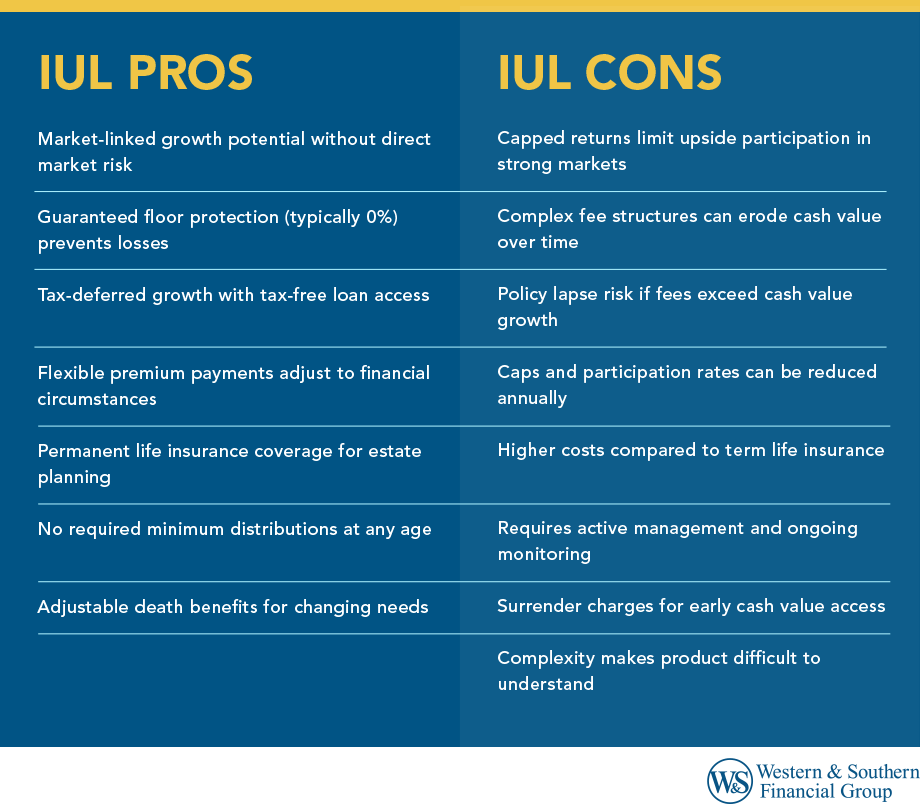
Cash Value Growth Mechanisms
- Indexed Universal Life (IUL) insurance ties the cash value growth to the performance of a market index, such as the S&P 500. This allows for potentially higher returns compared to traditional fixed-interest models, especially during strong market years, while also typically including a floor (often 0%) to protect against market losses.
- Whole Life insurance offers guaranteed cash value growth at a fixed interest rate set by the insurance company. This provides predictability and stability, making it attractive for conservative investors who prioritize safety over high returns.
- IUL policies often include caps, participation rates, and spreads that limit the amount of index gains credited to the cash value, which can reduce returns even in bullish markets. In contrast, whole life does not offer market-linked upside but ensures steady, albeit modest, compounding over time.
- IUL policies generally offer flexible premium payments, allowing policyholders to adjust or skip premiums within certain limits, as long as there is sufficient cash value to cover costs. This provides financial adaptability, especially useful during periods of variable income.
- Whole Life requires fixed premium payments for the life of the policy to maintain guarantees. Missing payments can lead to lapse unless the policy has built up enough cash value to cover the shortfall through automatic premium loans.
- The cost of insurance charges in IUL can increase with age and may impact cash value accumulation if not managed actively. Whole life premiums are level and locked in at issuance, simplifying long-term financial planning despite typically being higher than initial IUL premiums.
Risk Exposure and Guaranteed Elements
- IUL policies expose the cash value to market index performance but typically shield it from direct losses through a no-negative-equity guarantee. However, the trade-off is limited upside due to caps and other crediting method restrictions, introducing complexity in projecting long-term value.
- Whole Life policies provide a high degree of predictability with guaranteed death benefits, fixed premiums, and assured cash value growth. This makes them less risky and easier to understand, which benefits individuals seeking financial stability without market exposure.
- IUL's variable nature requires more active monitoring and understanding of index behavior, policy caps, and interest crediting strategies. Whole life, in contrast, demands less oversight and management, offering a set-it-and-forget-it approach suitable for hands-off policyholders.
Who Should Consider Indexed Universal Life Insurance Based on Its Pros and Cons?
:max_bytes(150000):strip_icc()/Pros-and-cons-indexed-universal-life-insurance_final-1b83c0fd52154eb69edd47f99ab8927a.png)
Individuals Seeking Tax-Advantaged Growth with Flexibility
Indexed Universal Life (IUL) insurance may be a strategic choice for individuals who want to grow their savings in a tax-efficient manner while maintaining access to their funds.
 Business Insurance For Dentists
The cash value in an IUL policy grows based on the performance of a market index, such as the S&P 500, without direct market exposure—meaning the policyholder won’t lose money due to market downturns, thanks to a guaranteed floor (often 0%). This makes it appealing for those who desire upside potential but wish to avoid the risks of direct stock market investment.
Additionally, policyholders can borrow against the cash value or make withdrawals for major expenses, such as education or retirement, without triggering taxable events if managed properly. This blend of growth potential, downside protection, and liquidity creates a compelling option for financially disciplined individuals aiming to supplement retirement income or estate planning.
- People in higher tax brackets may benefit significantly from the tax-deferred growth and potential tax-free withdrawals if policy guidelines are followed.
- Individuals who have maxed out other tax-advantaged accounts like IRAs or 401(k)s may use IUL as an additional savings vehicle.
- Those seeking flexible premium payments can adjust contributions within limits, aligning with changing financial circumstances over time.
Families and High-Net-Worth Individuals with Estate Planning Needs
For families with substantial assets or individuals concerned about estate taxes, Indexed Universal Life insurance can serve as an effective wealth transfer tool.
The death benefit is generally paid income-tax-free to beneficiaries and can be structured to help cover estate tax liabilities, preserving the estate’s value. This is particularly relevant in jurisdictions where estate or inheritance taxes apply to large estates. Moreover, IUL policies can be used within irrevocable life insurance trusts (ILITs) to further remove the death benefit from the taxable estate.
This strategic use allows high-net-worth individuals to leave a legacy without subjecting heirs to liquidity challenges during settlement. The combination of a guaranteed death benefit and long-term cash accumulation also appeals to those looking to balance protection with intergenerational financial planning.
- Families anticipating estate taxes can use the death benefit to provide immediate liquidity to cover tax obligations.
- Business owners may use IUL to fund buy-sell agreements or protect key person value.
- Those with complex estates can integrate IUL into broader trust strategies to enhance control and minimize tax exposure.
Long-Term Savers Who Want a Balance Between Risk and Reward
Indexed Universal Life insurance appeals to individuals who are committed to long-term financial planning and seek a middle ground between conservative fixed accounts and volatile equities.
Unlike traditional whole life insurance, IUL offers growth potential tied to market indices while protecting the principal from losses during market declines. For savers who are risk-averse but still want exposure to market gains—capped by a maximum interest rate—this hybrid structure provides a balanced approach.
It is especially suitable for those who can maintain the policy for decades, as early surrender charges and fees can diminish short-term value. The ability to tailor index crediting strategies—such as point-to-point or monthly sum caps—allows policyholders to customize their risk tolerance and growth expectations over time.
- Conservative investors uncomfortable with stock market volatility but seeking better returns than savings accounts may find IUL a suitable alternative.
- Individuals planning for retirement in 20+ years can benefit from compounding cash value growth without direct market risk.
- Policyholders willing to monitor and adjust their index allocations periodically can optimize returns based on market conditions.
Frequently Asked Questions
What are the main advantages of Indexed Universal Life Insurance?
Indexed Universal Life (IUL) insurance offers potential for cash value growth linked to market indexes like the S&P 500, with downside protection limiting loss. It provides flexible premiums and death benefits, tax-deferred cash growth, and tax-free withdrawals if structured properly. Policyholders can borrow against the cash value, making it a potential financial tool for retirement or emergencies while maintaining a death benefit for beneficiaries.
What are the potential drawbacks of Indexed Universal Life Insurance?
IUL policies can have high fees, complex structures, and caps on returns, limiting gains even when the market performs well. Premiums may increase over time, and poor performance or early surrender can reduce cash value. If loans aren’t repaid, the death benefit may be reduced. Understanding contract terms is crucial, as misleading illustrations or mismanagement can lead to unexpected outcomes or policy lapse.
How does the cash value growth work in Indexed Universal Life Insurance?
The cash value in an IUL policy grows based on the performance of a selected market index, such as the S&P 500. However, gains are subject to caps, participation rates, or spreads, which limit how much growth is credited. Importantly, the policy guarantees a minimum interest rate and protects against market losses—meaning cash value won’t decrease if the index falls, but it also won’t benefit from full market returns.
Is Indexed Universal Life Insurance a good investment option?
IUL is not a pure investment but a life insurance product with investment-like features. It may suit individuals seeking death benefit protection with potential cash value growth and tax advantages. However, high costs and caps make it less effective than direct market investments for wealth accumulation. It works best as part of a diversified financial plan, not a standalone investment strategy.
Leave a Reply